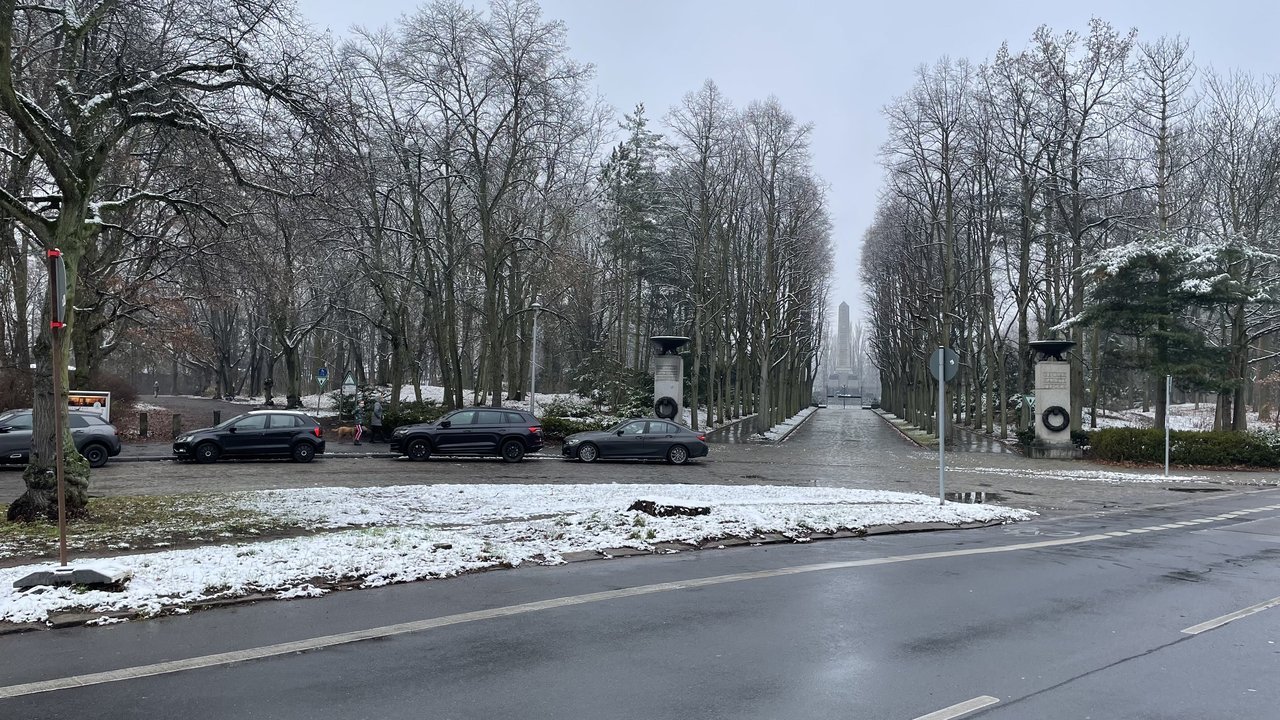
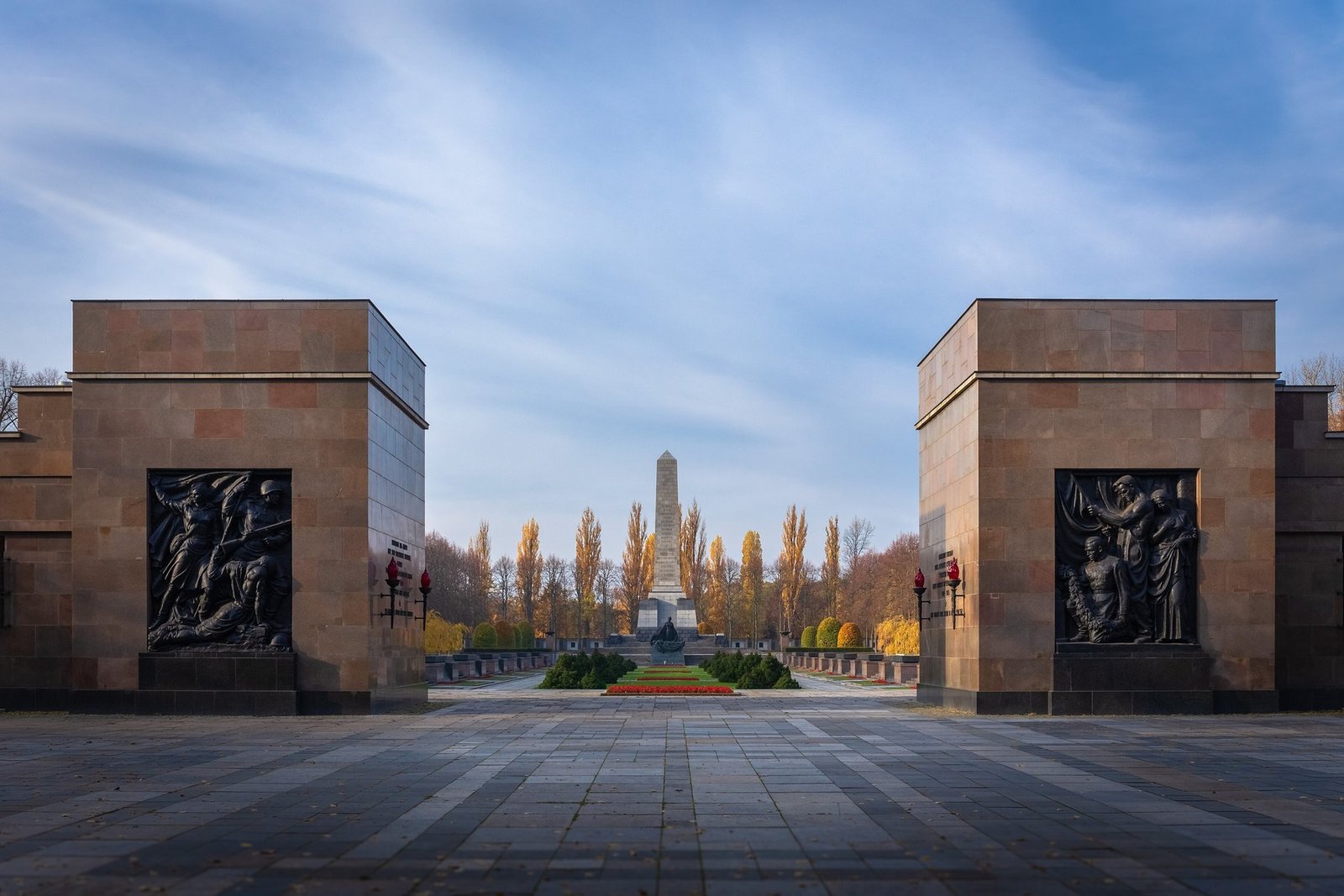
The gateway of the Soviet memorial in the Schönholzer Heide, Pankow, seen from the approach outside it, November 2018. The obelisk stands at the far end of the axis.Stefan Lux, 2018. Wikimedia Commons. CC BY 4.0.
The Soviet war memorials · Berlin · 1945–49
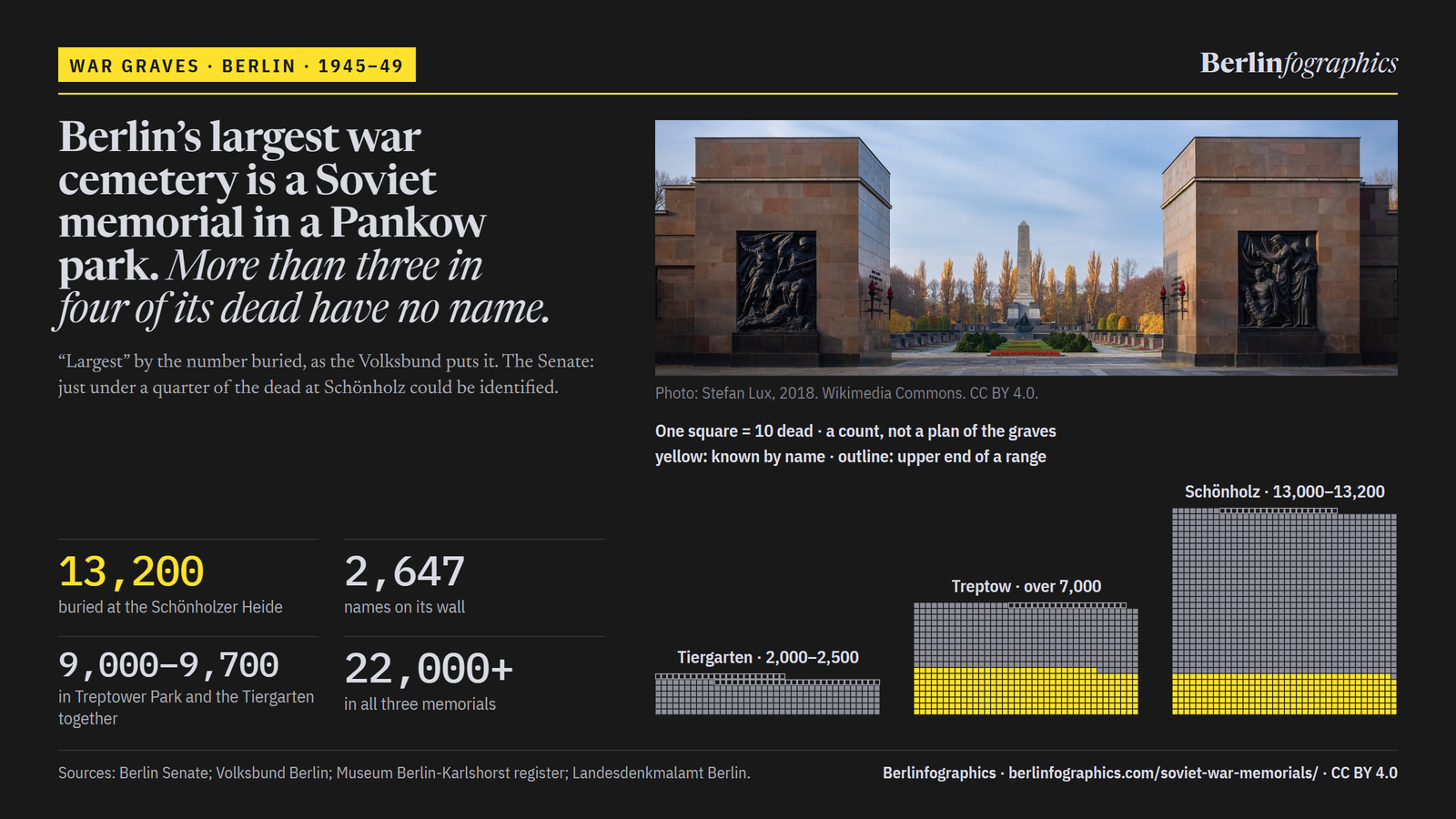
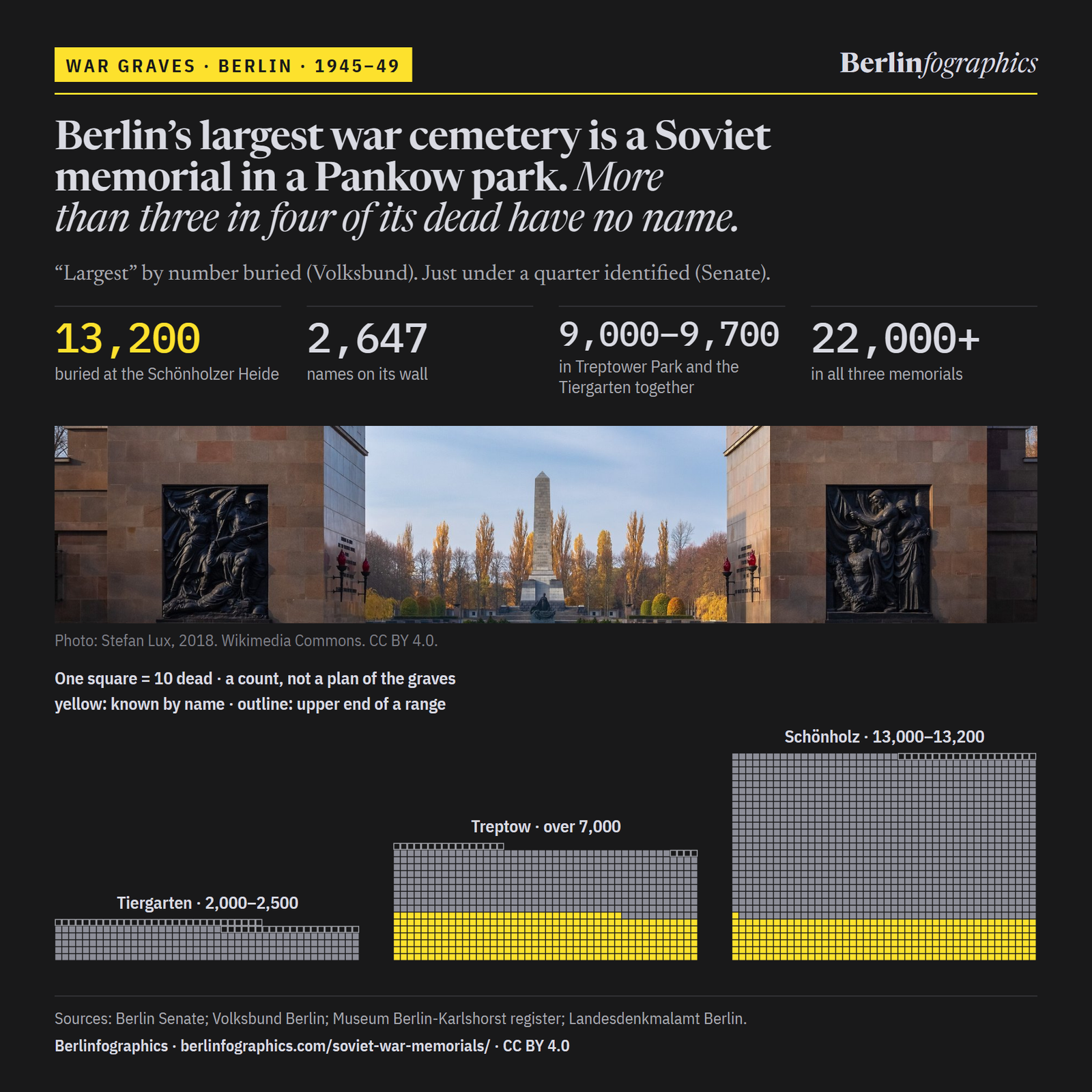
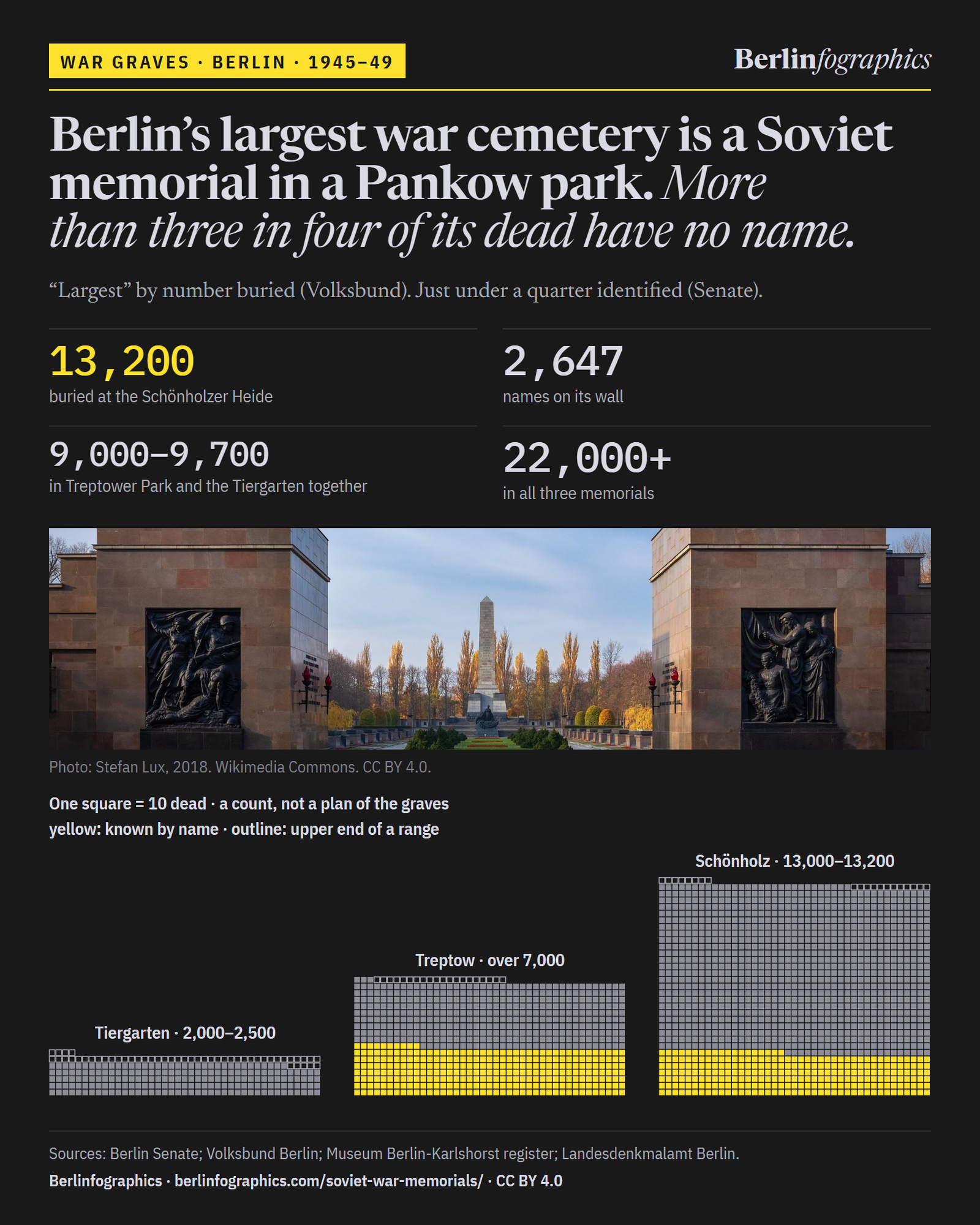
“Largest” is by the number buried, in the words of the Volksbund, Germany’s war graves commission: “die größte Kriegsgräberstätte Berlins”. The Senate says “Nur knapp 1/4 der Bestatteten konnte identifiziert werden”: just under a quarter of the buried could be identified.
Between 1945 and 1949 the Soviet Union put up three memorials in Berlin, for over 22,000 of its soldiers. The agreements that came with German unification mean Germany cannot change them on its own.
01Three cemeteries
Berlin’s three Soviet memorials are visited as monuments to a victory. They are also graves. The Senate counts over 22,000 Soviet soldiers who fell in the battle for Berlin buried in them, and all three are protected as war graves under the Gesetz über die Erhaltung der Gräber der Opfer von Krieg und Gewaltherrschaft (Gräbergesetz).
They were built between 1945 and 1949 with two aims. One was to give a proper burial to the Red Army dead of the battle for Berlin, many of whom had been buried makeshift in parks and open ground; the dead were moved to Treptow and Schönholz between 1947 and 1949. The other aim, the Senate says of Treptow, was political:
“Zum anderen errichtete die Sowjetunion hier bewusst ein Siegesmal als politisches Zeichen.”Berlin Senate, answer to parliament, 1 September 2025
One officer, Engineer-Major Grigori L. Kravtsov, ran the building of the Tiergarten memorial and from 1946 to 1948 headed the special staff for memorial construction in Berlin; he was also responsible for the Treptow and Schönholz memorials.

02The dead, and their names
Each square below stands for 10 dead. The three blocks are drawn to the same scale and fill in the order the memorials were dedicated. Where the sources disagree, the upper part of the block is an outline. The squares are a count, not a plan of the graves: no square stands for a person.
The three memorials · one square = 10 dead
11 November 1945
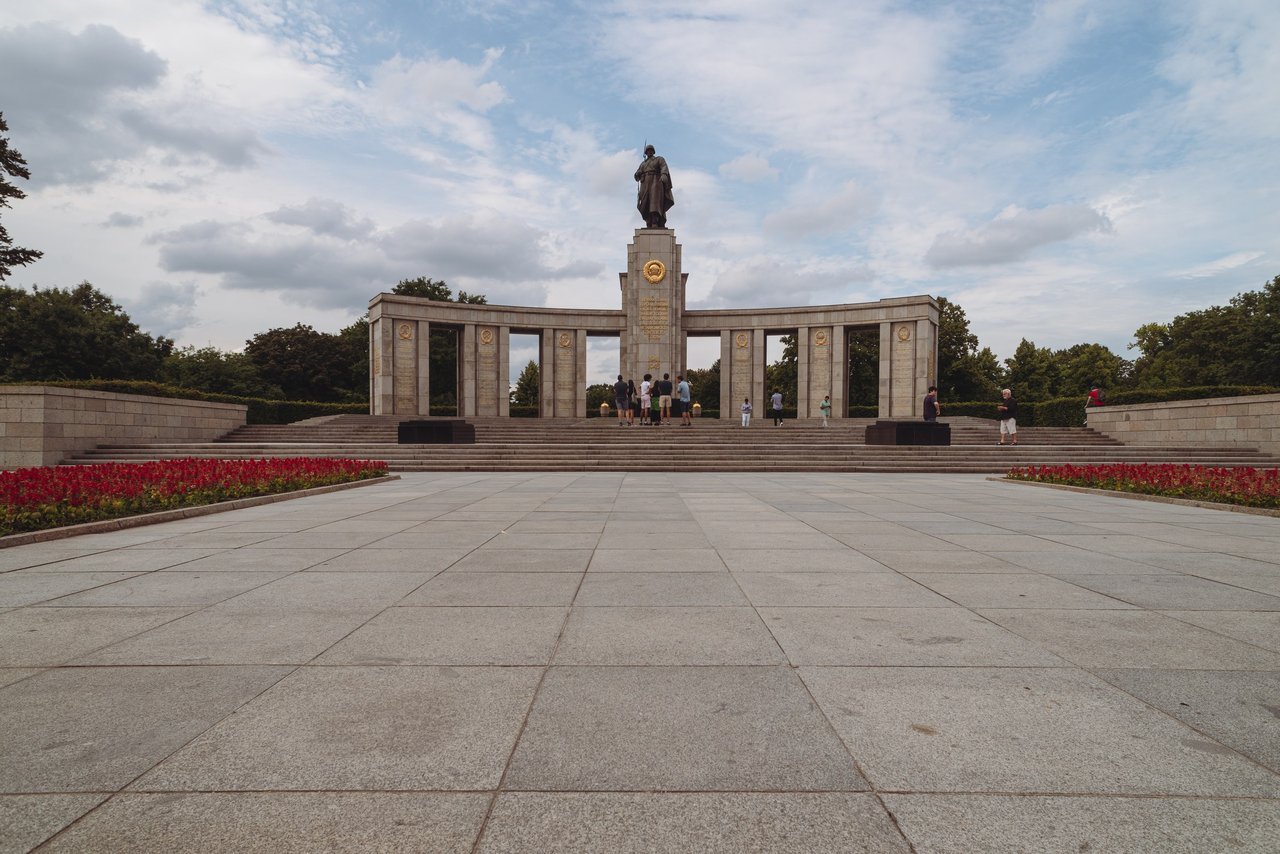
The first large memorial built in Berlin after the war stands across the axis Albert Speer had planned for the Nazi capital. Behind the colonnade lie 2,000 to 2,500 soldiers; the exact number is not known, and the single graves can no longer be made out.
In the British sector
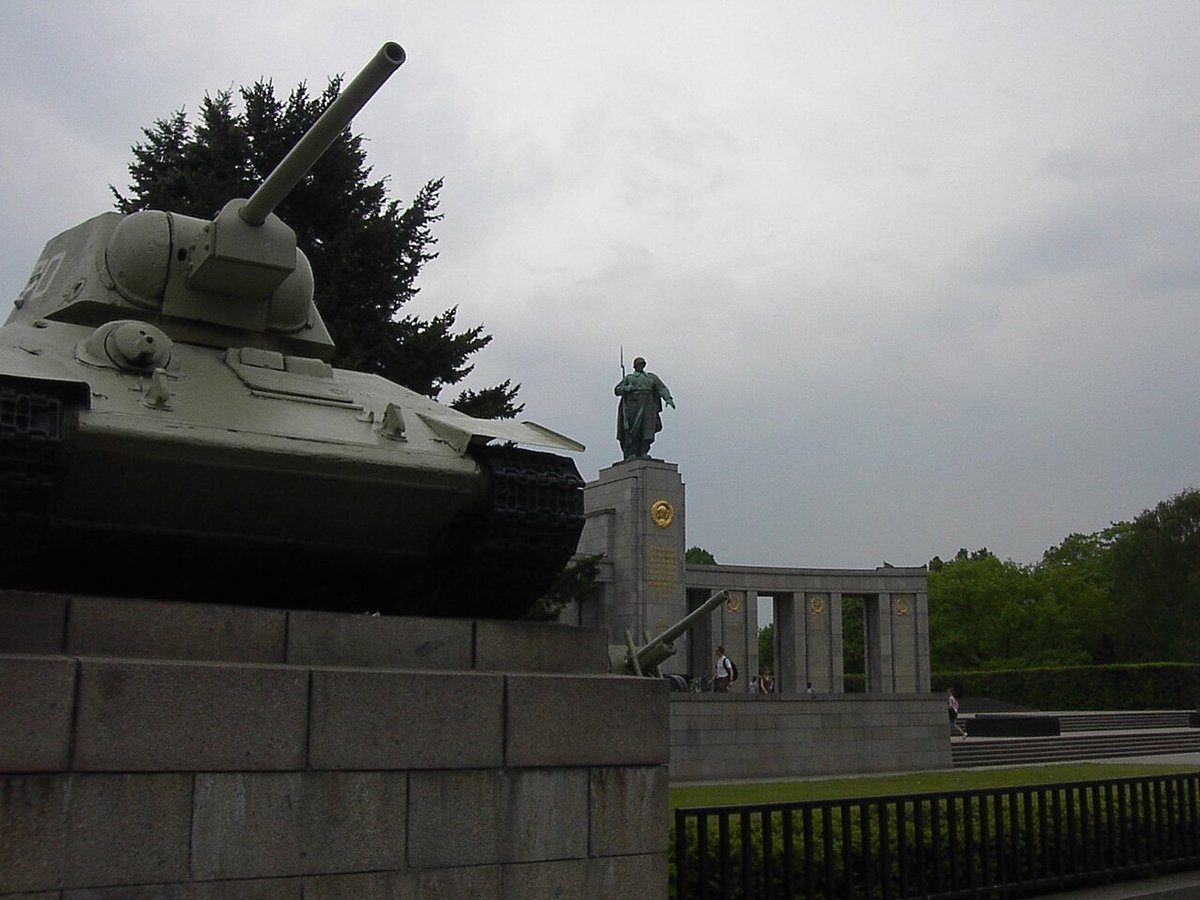
Two Soviet T-34 tanks and two guns stand at the entrance. The memorial lay in the British sector, as an enclave under Soviet administration; the Soviet guard of honour mounted for the last time on 22 December 1990. No count of names is published, so none of its squares is lit.
8 May 1949
Built by 1,200 workers. Over 7,000 soldiers are buried here; the Karlshorst register gives 7,200.
Senate, 11 November 2025
Only about 2,970 of them are known by name, the Senate told parliament. The memorial book in the crypt holds 2,300 names, and the records are incomplete: mostly initials, with gaps in the dates.
7 November 1949
In the Senate’s words the park “wurde im Zweiten Weltkrieg in ein großes Zwangsarbeiterlager umgewandelt”: it became a large forced labour camp. After the war the dead were buried here or moved here from across the city between 1947 and 1949. The Volksbund counts 13,200, the Senate over 13,000; 120 were women.
The wall of names
A wall 560 metres long carries 100 bronze tablets with 2,647 names. The Senate: “Nur knapp 1/4 der Bestatteten konnte identifiziert werden.” Grün Berlin says just under a fifth.
The wall stands inside the walled memorial; this story shows only views from public ground.
The three together
On every pairing of the figures, Schönholz holds more dead than the other two together: 13,000–13,200 against 9,000–9,700. The Volksbund calls it perhaps the least known of the three.
03Treptower Park
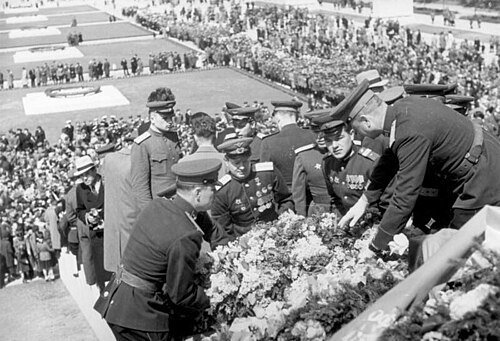
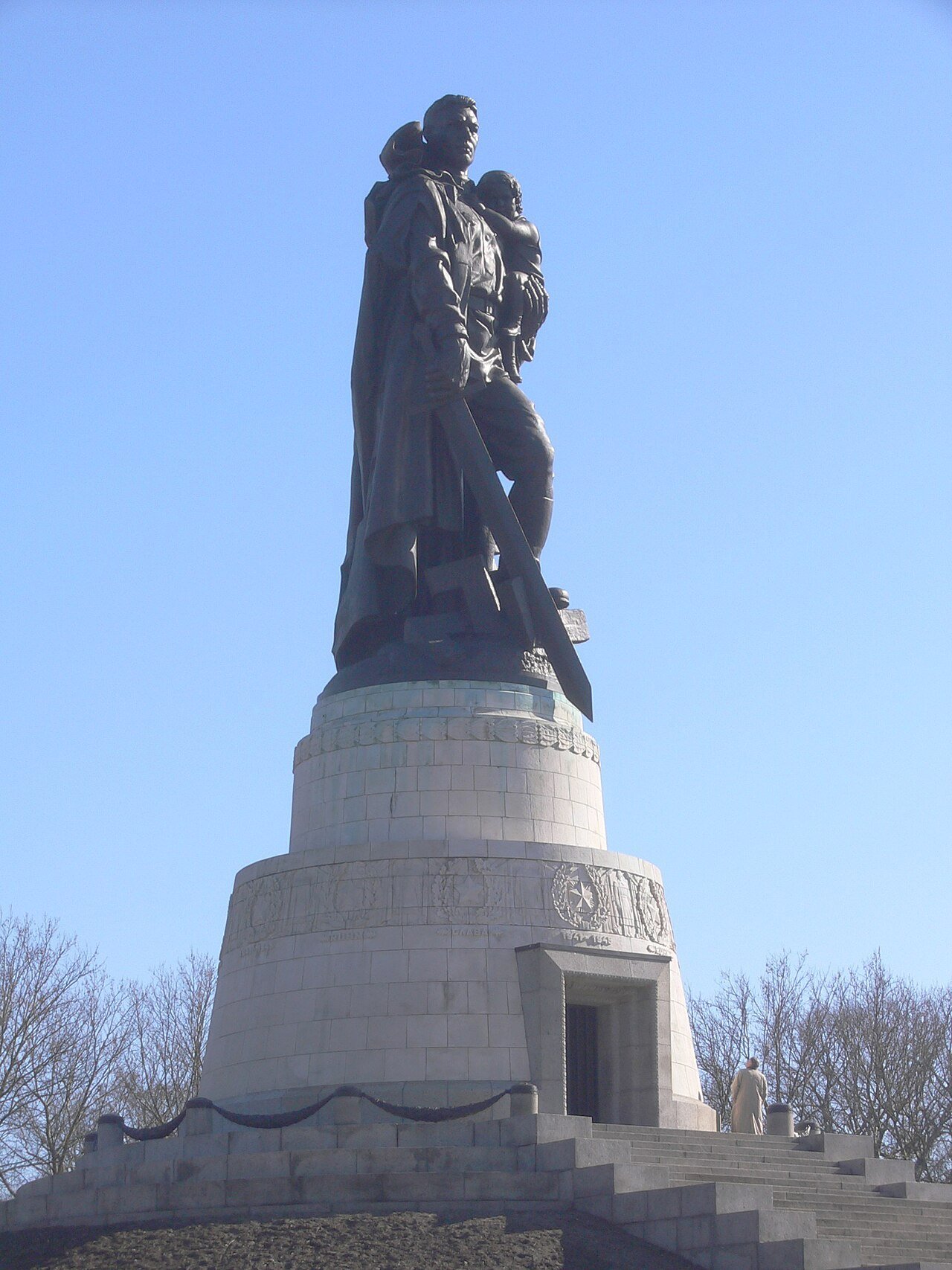
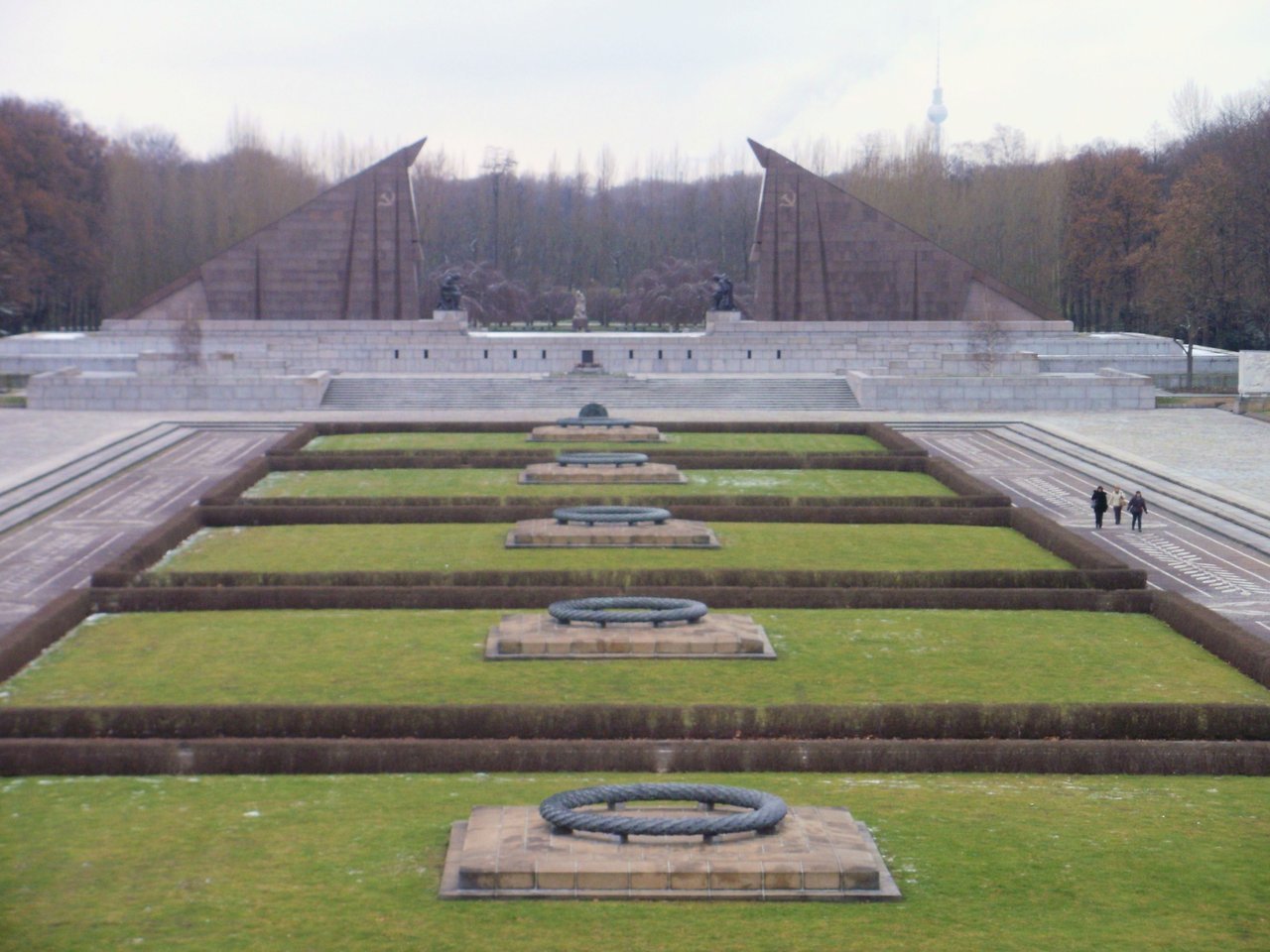
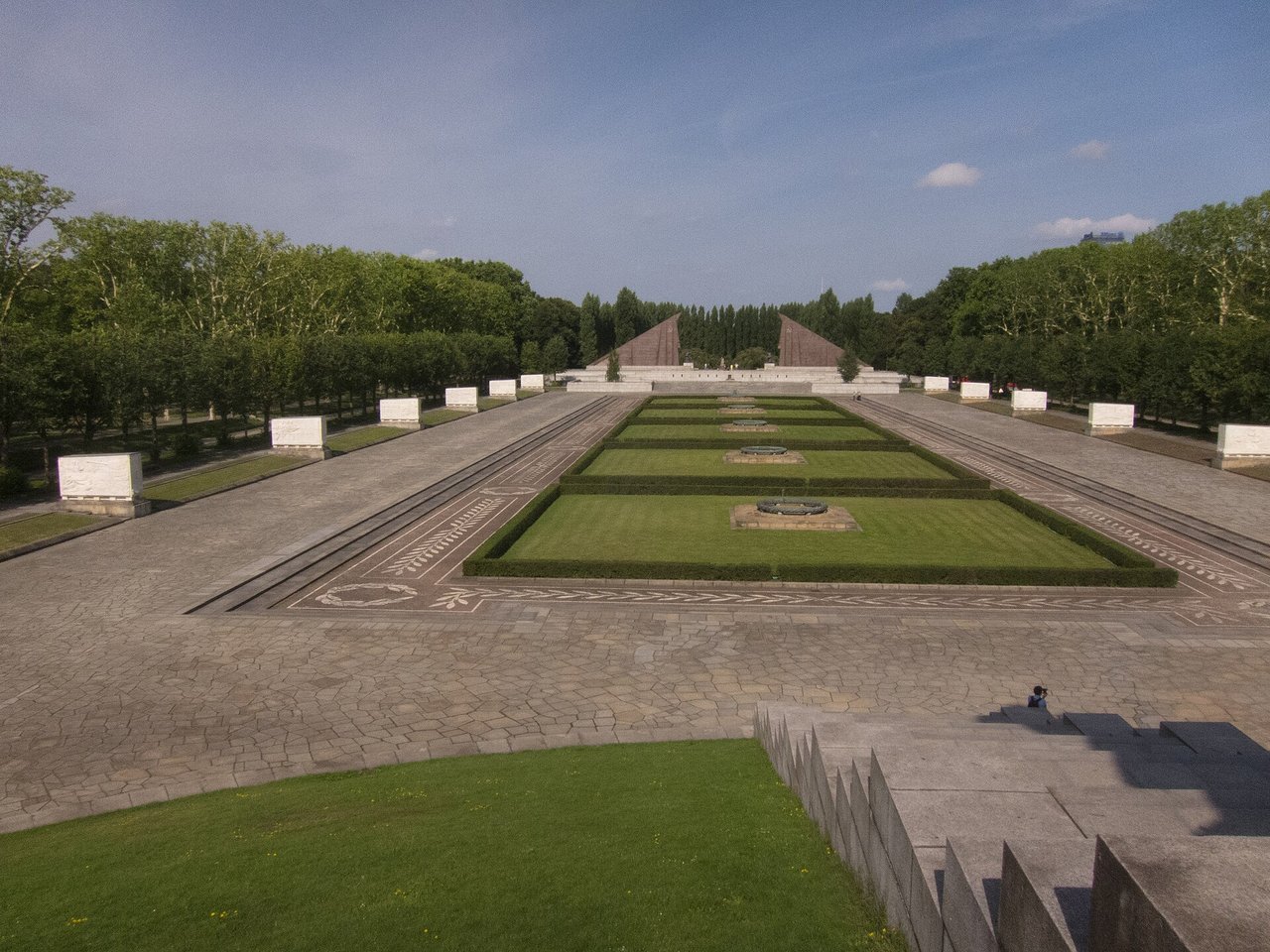
Along the central axis stand 16 limestone sarcophagi, eight on each side, standing for the sixteen Soviet republics of the time, with reliefs of the war of 1941–45. The axis ends at the bronze soldier with a rescued child on his arm and a lowered sword over a shattered swastika, standing on the mausoleum mound above a crypt.
The five lawns down the middle look like mass graves. According to the Senate and the Museum Berlin-Karlshorst register, they are not: the five lawn squares on the central axis are laid out symbolically as communal graves; no dead rest in them. The register says it plainly: “In den fünf Rasenquadraten in der Mittelachse ruhen keine Toten”. The graves lie behind the sarcophagi, in the lawns under the plane trees.
One holding institution disagrees. The Landesdenkmalamt’s page describes “fünf Rasenpartien, unter denen 4.800 Gefallene beigesetzt sind”: five lawns with 4,800 dead beneath them. This story follows the Senate and the register; the plan shows both.

Treptower Park · schematic plan, not to scale
Drawn after the Senate’s published ground plan, simplified; positions are schematic and nothing is measured. The Volksbund puts the grave area at a third of the site; the shading shows where, not how much. The dashed note records the Landesdenkmalamt’s contrary account.


04Beyond the three
But the three memorials are not the whole of it. The Volksbund found Soviet war victims in 74 of the city’s 171 grave sites for the victims of war and tyranny, more than 28,600 people in all. About 6,000 lie outside the three memorials, and at least 4,387 of those were not soldiers but people deported to Germany, usually forced labourers.
Berlin’s war grave sites · one square each
Squares and bar: Volksbund Berlin. The bar is drawn to one linear scale; the Volksbund’s total is a floor, so the part in the three memorials is shown without a figure of its own.
05The undertaking
Their protection is part of the agreements that came with German unification. In the joint letter that accompanied the Two-Plus-Four Treaty on 12 September 1990, the two German foreign ministers declared:
“Die auf deutschem Boden errichteten Denkmäler, die den Opfern des Krieges und der Gewaltherrschaft gewidmet sind, werden geachtet und stehen unter dem Schutz deutscher Gesetze.”The monuments on German soil dedicated to the victims of war and tyranny will be respected and are under the protection of German laws. Joint letter of 12 September 1990, point 2.
Article 18 of the German–Soviet treaty of 9 November 1990 repeats the undertaking for Soviet monuments and war graves. The war graves agreement with Russia of 16 December 1992 leaves the grounds to the other side as permanent resting places, and their boundaries can be changed only by mutual agreement. The Bundestag’s research service concluded in 2023 that a one-sided change by Germany is excluded and would be a breach of treaty.
On 31 August 1994, Chancellor Helmut Kohl and President Boris Yeltsin took leave of the last Russian troops in Treptower Park. In 2025, asked about the Stalin quotations on the Treptow site, the Senate answered that they are an integral part of the monument, and that “Eine Veränderung oder Entfernung einzelner Elemente”, changing or removing single elements, is “faktisch ausgeschlossen”: in practice ruled out.

06Since 2022
Since 24 February 2022 the Senate has kept no contact with official representatives of the Russian Federation. In its answer of 29 November 2024 it said it had held its own commemoration at the Schönholzer Heide and planned to do so again the following May, for the soldiers of the Red Army “unabhängig von ihrer damaligen oder heutigen Nationalität”, whatever their nationality then or now.
For 8 May 2025, 6 a.m., to 9 May, 10 p.m., a police general order covered the three memorials and their surroundings and banned, among other things, flags with a Russian reference; veterans of the war and diplomats were exempt. On 6 May 2025, in summary proceedings, the Verwaltungsgericht Berlin refused an association's urgent application against the ban on Soviet flags at Treptow (VG 1 L 492/25).
Asked about reading out the names of the Treptow dead, the Senate held that reading aloud the names of war dead from publicly accessible sources needs no one's consent and is a customary and fitting form of remembrance.
This story is about the graves and what has been done with them. It does not discuss the conduct of Red Army soldiers in Berlin in 1945; that is told in The rapes in Berlin, 1945.
Writing about its own commemoration at the Schönholzer Heide, the Senate added:
“Those buried there came from all the regions of the former Soviet Union.”
Press & citation
Free to publish under CC BY 4.0 — in print, online, on Wikipedia and in teaching, commercially or not — with credit to Berlinfographics and a link to this page.
Ready-to-use image
The infographic as one image: headline, key figures, chart, sources and credit, 2,400 × 1,350 px PNG. Please use it unedited.
Download landscape (PNG)
Square format
A 1:1 version for social media and narrow columns, 1,800 × 1,800 px.
Download square (PNG)
Portrait 4:5
For Instagram and LinkedIn feeds, 1,620 × 2,025 px.
Download portrait (PNG)Credit line
Berlinfographics (berlinfographics.com), CC BY 4.0
Citation
Berlinfographics (2026). “The Soviet war memorials in Berlin”. Berlin Experiences. https://berlinfographics.com/soviet-war-memorials/
Wikipedia
{{cite web |title=The Soviet war memorials in Berlin |url=https://berlinfographics.com/soviet-war-memorials/ |website=Berlinfographics |publisher=Berlin Experiences |date=2026-11-19 |access-date=2026-11-19}}
Our infographics, charts and texts are licensed CC BY 4.0: free to republish, including commercially, with credit to Berlinfographics and a link. Photographs keep their own licences, named in each caption. How to credit
Topics: The Second World War · Cold War Berlin · Nazi Berlin · Persecution & the Holocaust · Weimar Berlin · Prussia & the Kaiserreich · Architecture & the built city · Culture, science & society · Reunified Berlin · Unusual facts
Contact: info@berlinfographics.com · Press: press@berlinfographics.com · Imprint · Privacy