Berlinfographicsby Berlin Experiences

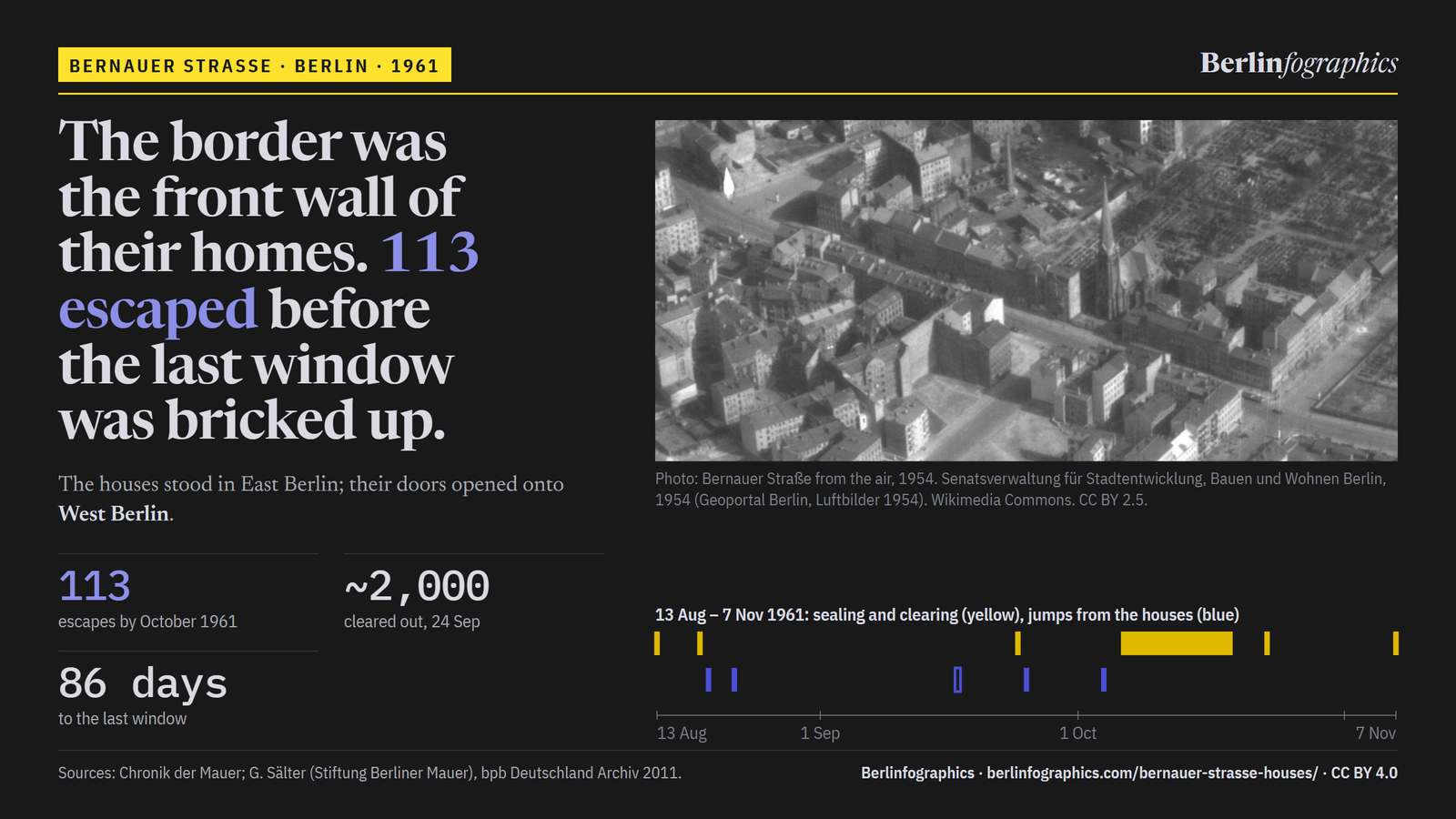
Bernauer Straße from the air, June 1954. The row with the Versöhnungskirche’s spire stood in the Soviet sector; the street in front of it was West Berlin.Photo: Senatsverwaltung für Stadtentwicklung, Bauen und Wohnen Berlin, 1954 (Geoportal Berlin, Luftbilder 1954). Wikimedia Commons. CC BY 2.5.

Bernauer Straße

On Bernauer Straße the border was the front wall of people’s homes. 113 people escaped from the street before the last window was bricked up.

The houses stood in East Berlin; the pavement at their doors was West Berlin. East Berlin took 86 days in 1961 to seal them: the doors first, then the ground floors, then, house by house as the tenants were cleared out, every window. People jumped all the while. Rudolf Urban, Ida Siekmann, Olga Segler and Bernd Lünser died trying.

113
successful escapes from Bernauer Straße by October 1961
~2,000
people cleared out of the houses on the morning of 24 September
86days
from the closing of the border to the last bricked-up window
1979–80
until then, the ground floors of the houses were the Wall
01Mitte and Wedding, 1945–1961

The border ran along the house fronts, so every front door opened onto the West

Bernauer Straße divided two districts and, after 1945, two sectors. The houses on its south side were in the Soviet sector, in Mitte; the pavement in front of them was French, part of Wedding. The buildings “could only be entered from the sidewalk situated in West Berlin”.

When the SED closed the sector border on 13 August 1961, those doors still led west, and many tenants of the border houses fled in the first days and weeks. What East Berlin did next, door by door and floor by floor, is drawn below.

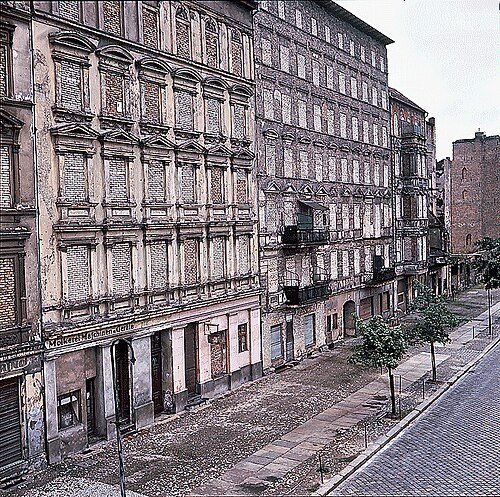
Tall old tenement fronts with every window filled with bricks, a cobbled pavement and young trees in front.
Bricked-up house fronts on Bernauer Straße, seen from a West Berlin viewing platform, 1965.Photo: Willy Pragher, 1965. Landesarchiv Baden-Württemberg, Staatsarchiv Freiburg, W 134 Nr. 078925. Wikimedia Commons. CC BY 4.0.

Bernauer Straße today, with the Wall as it stood in 1989

By 1989 the Wall ran along the south side of the street, where the border houses had stood (the last of them gave way to it in 1980). Wall lines: Geoportal Berlin, “Verlauf der Berliner Mauer, 1989”, dl-de/zero-2.0. Streets and places: © OpenStreetMap contributors, ODbL.

0213 August to 7 November 1961

East Berlin sealed the houses from the ground up, and people kept jumping

The doors went first, then the ground-floor windows. The upper windows stayed open for weeks, and 113 people had got out of the street by October 1961. The street windows were bricked up only after the tenants had been cleared out, house by house.

86 days on Bernauer Straße

Above: a schematic of five house fronts on the south side of Bernauer Straße, numbered 1, 13, 34, 44 and 48, with their doors and windows facing the West Berlin pavement. Below: the days from 13 August to 7 November 1961 on one linear scale, with each dated event marked. The doors, then the windows, are bricked up as the story is read.
open door or windownailed shut or bricked upsealing and clearinga jump from the houses

Above: a schematic of five of the street’s house fronts, the ones this story names; their size, storeys and windows are not drawn to scale or count. Below: the 86 days on one linear scale; each mark sits at its date.

13 August 1961

Every front door opens onto West Berlin

The SED closes the sector border. On Bernauer Straße it runs along the house fronts, so the front doors on the south side still open onto the West Berlin pavement.

Tall old tenement fronts with every window filled with bricks, a cobbled pavement and young trees in front.
Bricked-up house fronts on Bernauer Straße, seen from a West Berlin viewing platform, 1965.Photo: Willy Pragher, 1965. Landesarchiv Baden-Württemberg, Staatsarchiv Freiburg, W 134 Nr. 078925. Wikimedia Commons. CC BY 4.0.

From 18 August

The doors are nailed shut

Entrances facing the West Berlin pavement are nailed shut or bricked up, and new ones are cut through the courtyards. Then the ground-floor windows are walled up. The upper windows stay open.

A long four-storey brick building behind bare trees, a wall with graffiti and parked cars along a street in front.
The Lazarus hospital on the West Berlin side of Bernauer Straße, 2013. Ida Siekmann died on the way here; Rudolf Urban died here.Photo: Brewer Bob, 2013. Wikimedia Commons. CC BY-SA 4.0.

19 August

Rudolf Urban, 47, climbs down a rope

Urban and his wife tie a rope to their window frame at Bernauer Straße 1 and slide down to the street. Both are hurt. He dies of pneumonia in the West Berlin Lazarus hospital on 17 September.

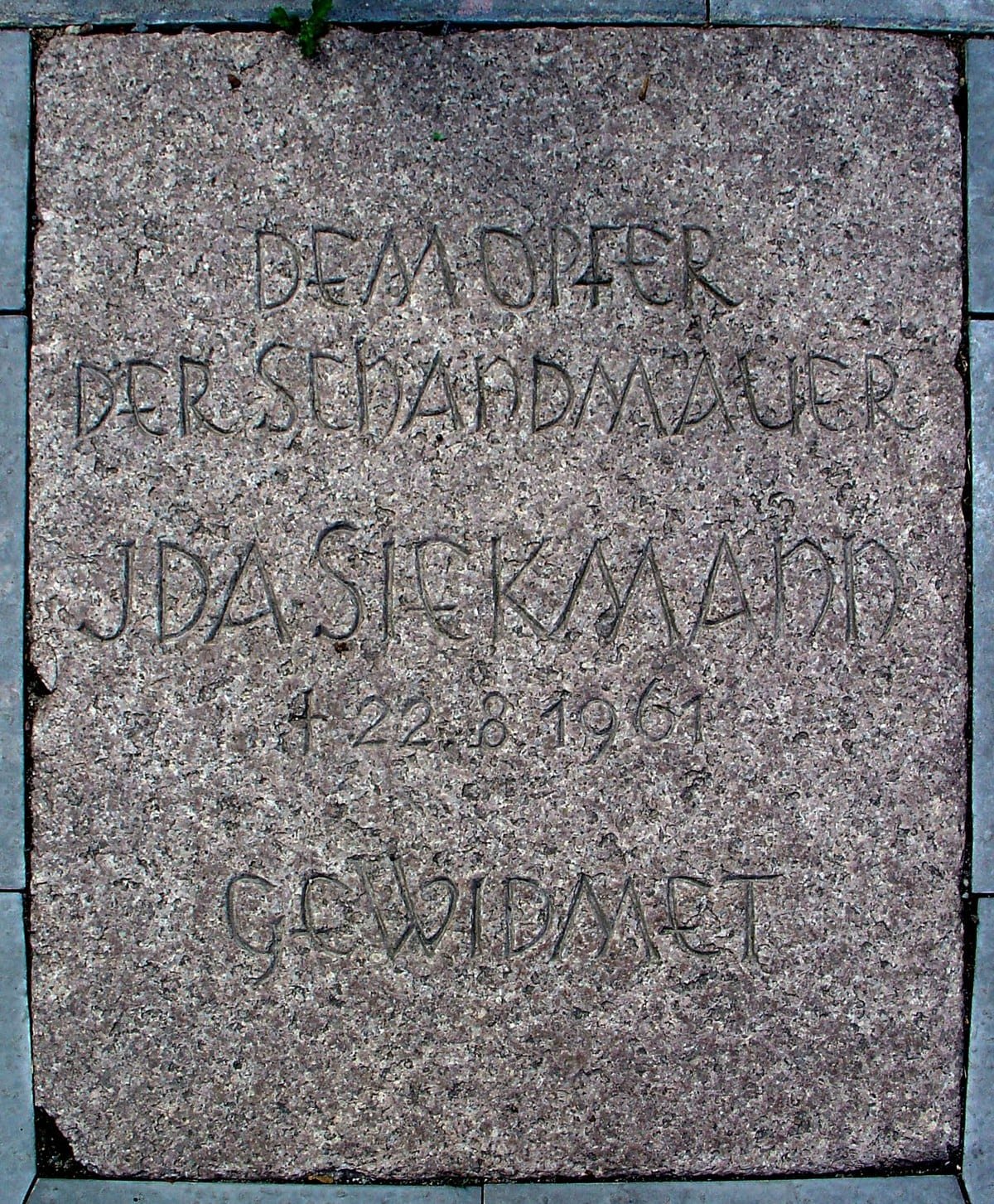
A square granite stone set in paving, with the carved words ‘Dem Opfer der Schandmauer Ida Siekmann, 22.8.1961, gewidmet’.
The memorial stone for Ida Siekmann on Bernauer Straße: “Dem Opfer der Schandmauer Ida Siekmann † 22.8.1961 gewidmet”.Photo: Katzenmeier, 2007. Wikimedia Commons. Public domain.

22 August, about 6:50

Ida Siekmann is the first to die at the Wall

A day after her front door is barricaded, she throws her bedding from her third-floor flat at no. 48 and jumps after it, before the firemen’s sheet arrives. She dies on the way to the Lazarus hospital, a day before her 59th birthday.

24 September

About 2,000 people are cleared out in one morning

50 to 80 houses are emptied before noon, and 13 people escape from the windows that day. Two days later the party paper Neues Deutschland reports: “Last Sunday, 140 families moved from Bernauer Strasse.”

A square granite stone set in paving, carved ‘Dem Opfer der Schandmauer Olga Segler, 26.9.1961, gewidmet’.
The memorial stone for Olga Segler on Bernauer Straße: “Dem Opfer der Schandmauer Olga Segler † 26.9.1961 gewidmet”.Photo: Katzenmeier, 2007. Wikimedia Commons. Public domain.

25 September

Olga Segler, 80, jumps into the firemen’s net

As the clearance reaches Bernauer Straße 34, she jumps from her flat. West Berlin firemen catch her, but she dies of her injuries the next day.

A weathered square stone set in paving, carved with a dedication to Bernd Lünser.
The memorial stone for Bernd Lünser on Bernauer Straße.Photo: Katzenmeier, 2007. Wikimedia Commons. Public domain.

4 October

Bernd Lünser, 22, misses the net

Surprised on the roof of Bernauer Straße 44, he jumps and misses the rescue net by a few metres. West Berlin police return the border guards’ fire.

A tenement front with every window bricked up, a small memorial and wreath on the pavement in front, cobbles in the foreground.
Bernauer Straße 48, 1965: the house Ida Siekmann jumped from, every window bricked up, and the memorial put up for her on the West Berlin pavement.Photo: Willy Pragher, 1965. Landesarchiv Baden-Württemberg, Staatsarchiv Freiburg, W 134 Nr. 078927. Wikimedia Commons. CC BY 3.0.

6 October – 7 November

The last windows are bricked up

Evictions resume from 6 October to 19 October; the Versöhnungskirche’s parsonage is cleared on 23 October. On 7 November masons brick up the last windows, at no. 13.

03Bernauer Straße, 1961–1990

Until 1979 or 1980, what was left of the houses was the Wall

In October 1965 demolition crews began tearing the empty houses down, but only to the ground floor. Their bricked-up ground-floor fronts were left standing as the border wall until 1979 or 1980; the sources differ. Olga Segler’s house came down in 1966, except for its ground-floor front.

What stood on the border line, 1961–1990

upper windows open, Aug–Nov 1961bricked up and emptyground-floor fronts as the Wallconcrete wall1979 or 1980

One linear scale of years. Where the sources disagree (the end of the façade wall, 1979 or 1980), the change is drawn as a hatched band across both years.

Black-and-white photograph: a tenement collapsing in a cloud of dust behind a fence, a church spire at the left edge.
A border house at the corner of Bernauer Straße and Ackerstraße is blown up, December 1965.Photo: ELAB, Archiv der Versöhnungsgemeinde, 1965. Wikimedia Commons. CC BY-SA 4.0.
A long run of one-storey ruined house fronts with bricked-up doors and windows, a chain barrier and a pavement with trees beside it.
The ground-floor fronts of the border houses as the Wall, Bernauer Straße, 1977: doorways and windows bricked up, the West Berlin pavement beside them.Photo: ELAB, Archiv der Versöhnungsgemeinde, photo: Hans-Joachim Burmeister, 1977. Wikimedia Commons. CC BY-SA 4.0.
Looking down on a street with a line of low, bricked-up house remains, a death strip with lamps behind and tall apartment blocks beyond.
The remains of the house fronts still standing as the Wall on Bernauer Straße, 1978, seen from West Berlin, with the strip and its lamps behind them.Photo: Willy Pragher, 1978. Landesarchiv Baden-Württemberg, Staatsarchiv Freiburg, W 134 Nr. 111135. Wikimedia Commons. CC BY 4.0.
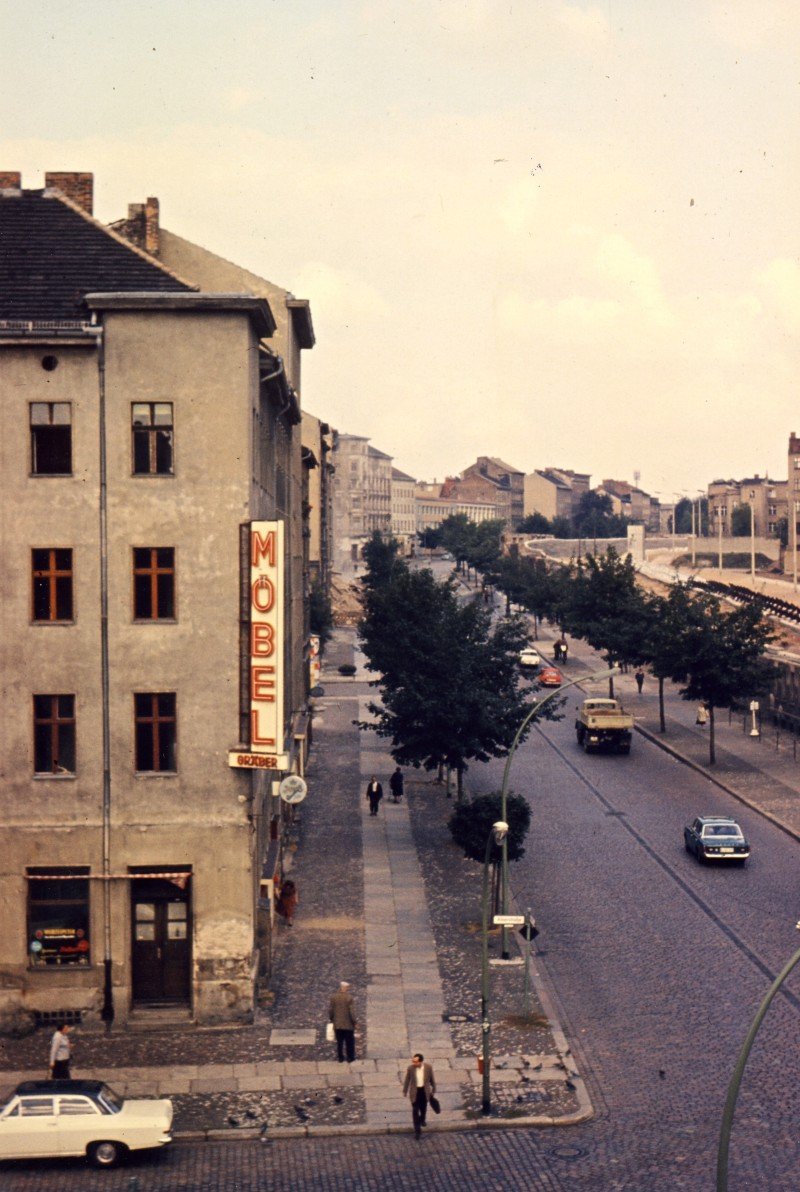
Colour photograph looking down a long cobbled street: a corner house with a ‘Möbel’ sign on the left, a wall, barriers and a cleared strip on the right.
Bernauer Straße at the corner of Ackerstraße, 1966, from the West Berlin side. On the right, where the border houses had been cleared, the Wall and the strip; on the left, the West Berlin houses.Photo: ELAB, Archiv der Versöhnungsgemeinde, 1966. Wikimedia Commons. CC BY-SA 4.0.
A line of tall concrete wall slabs casting a shadow on a pavement, a wide cleared strip and tenements behind.
The Wall being rebuilt in concrete on Bernauer Straße, September 1980.Photo: Eckhard Etzold, 1980. Wikimedia Commons. CC BY-SA 2.0 de.

When the new concrete wall went up in 1980, the last of the house fronts gave way to it. It stood until June 1990, when the demolition of the border began at the corner of Bernauer Straße and Ackerstraße.

04Versöhnungskirche, 1894–1985

A church stood in the death strip for twenty-three years, out of reach from either side

The Versöhnungskirche, built in 1894, stood on the south side of the street; the border ran a few metres from its entrance. From August 1961 it stood inaccessible, in the death strip. East Berlin blew up its nave on 22 January 1985 and its tower six days later.

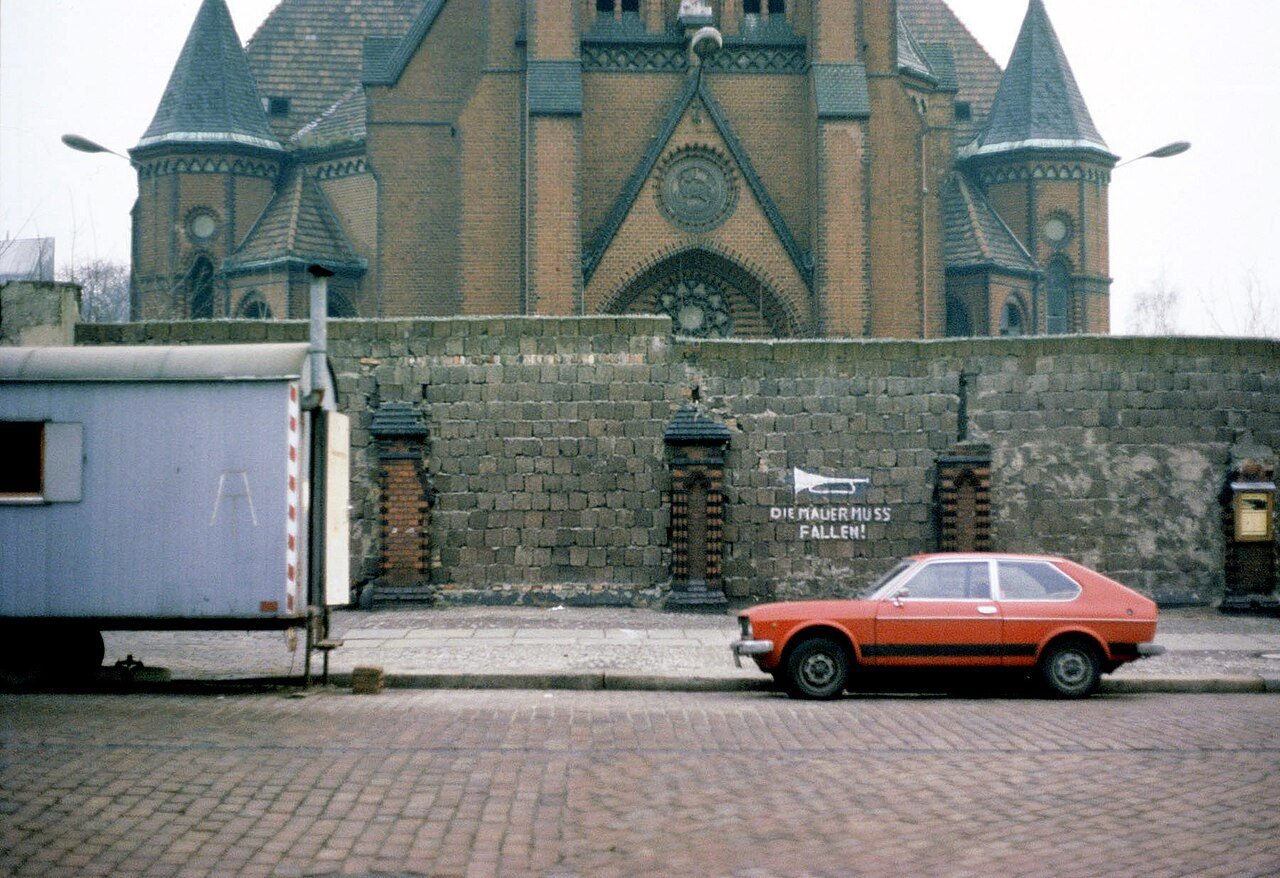
A red-brick neo-Gothic church front rising behind a stone wall, a small orange car and a site hut in the street in front.
The Versöhnungskirche behind the Wall, 12 January 1978. It stood in the death strip, out of reach from either side.Photo: Olga Bandelowa, 1978. Wikimedia Commons. CC BY-SA 2.0 de.
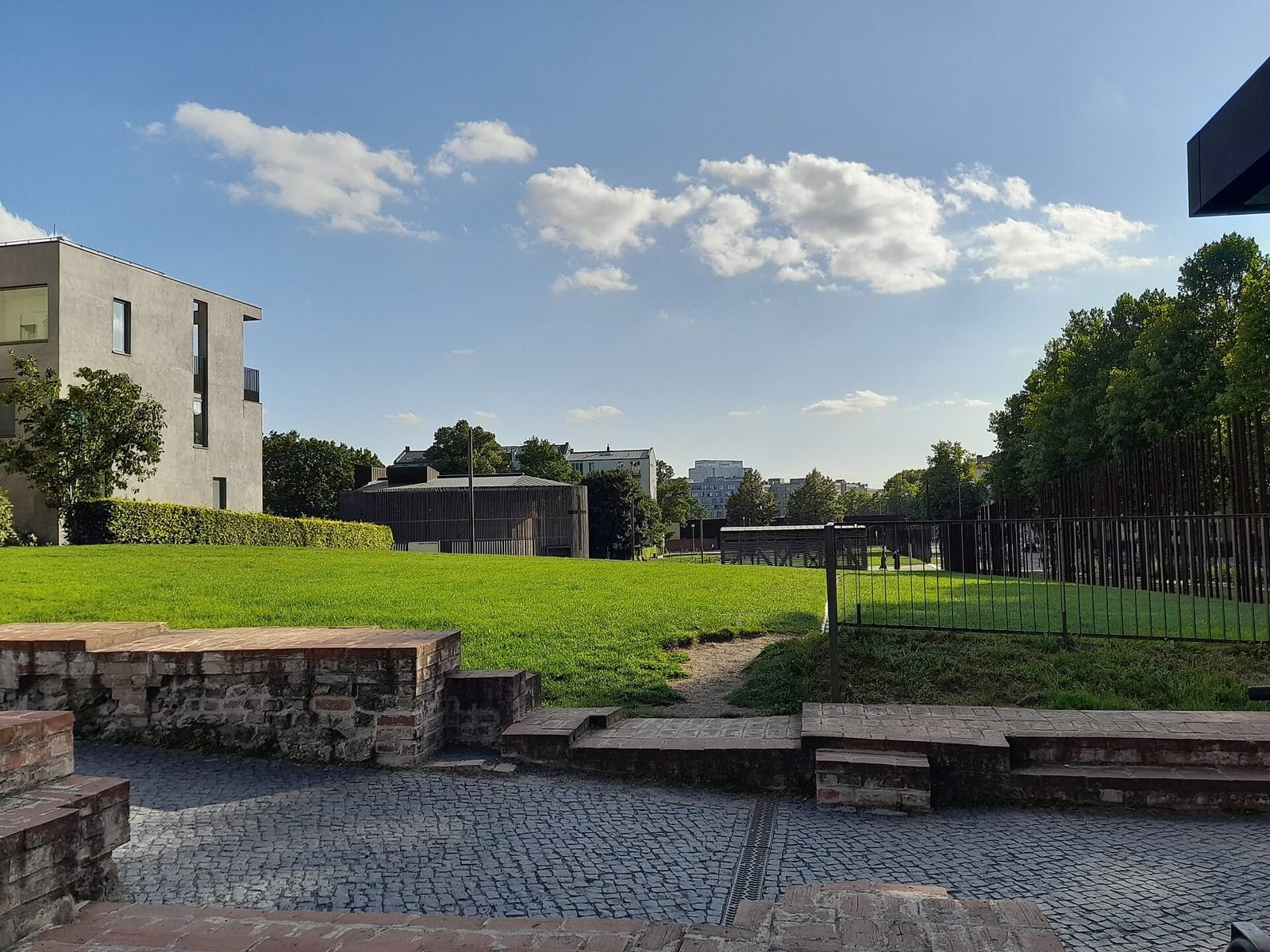
Low, worn brick foundation walls and cobbles in the foreground, a lawn behind, a slatted oval chapel and the memorial’s rows of steel rods in the distance.
The excavated brick foundations of the Versöhnungskirche, blown up in January 1985, in the Berlin Wall Memorial, 2025. The Kapelle der Versöhnung stands beyond them.Photo: Aagnverglaser, 2025. Wikimedia Commons. CC BY-SA 4.0.

05The Berlin Wall Memorial

The houses are marked out in the ground where they stood

The Berlin Wall Memorial runs 1.4 kilometres along Bernauer Straße. In its grounds the outlines of the buildings are marked in the ground, and the cellar of the building at no. 10a has been dug out. Part of the strip has been a protected monument since 2 October 1990.

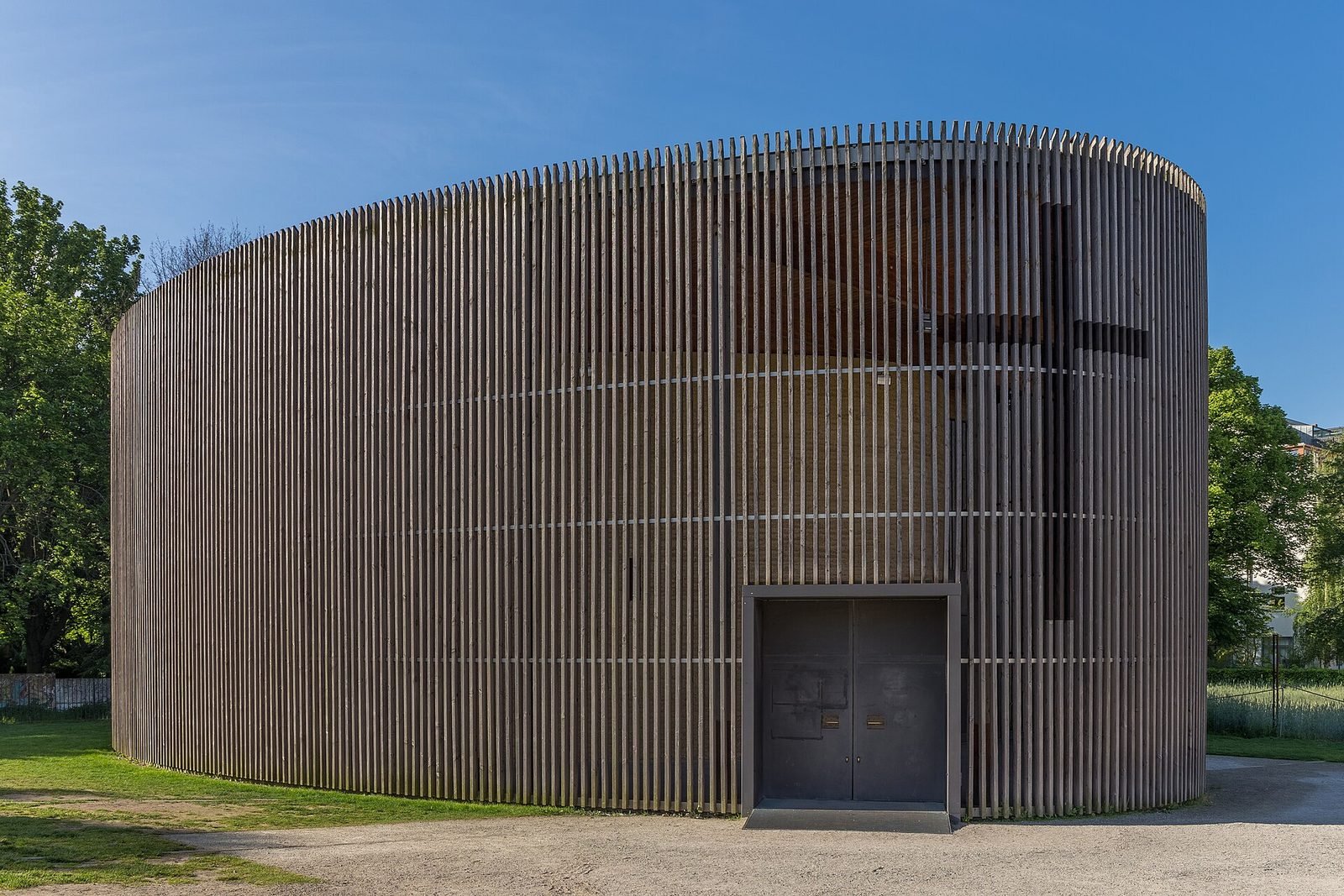
Where the Versöhnungskirche stood, the Kapelle der Versöhnung was consecrated on 9 November 2000. Memorial stones on the street name Ida Siekmann, Olga Segler and Bernd Lünser. For Ida Siekmann, the Wedding district put up a memorial at the spot in September 1961.

An oval building clad in vertical wooden slats on a lawn under a blue sky, a wooden cross set into its front.
The Kapelle der Versöhnung, consecrated in 2000 where the Versöhnungskirche stood, 2015.Photo: Ansgar Koreng, 2015. Wikimedia Commons. CC BY 3.0 de.
View from above over a wall, a sandy strip with lamp posts, a second wall and a park, the television tower on the skyline.
The preserved border strip of the Berlin Wall Memorial on Bernauer Straße, March 2005: the Wall in front, the strip and its lamps, the hinterland wall beyond.Photo: AarhusJ, 2005. Wikimedia Commons. Public domain.
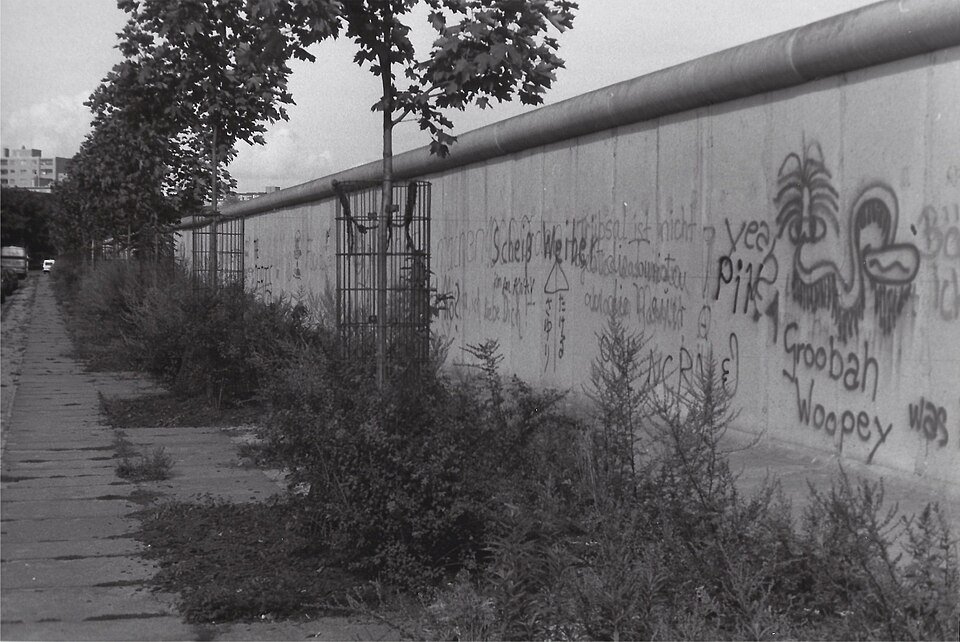
A long concrete wall covered in graffiti beside a pavement with trees.
The Grenzmauer 75 at Bernauer Straße and Bergstraße, about 1985. Between the pavement and the Wall, a strip of East Berlin ground.Photo: ELAB, Archiv der Versöhnungsgemeinde, 1985. Wikimedia Commons. CC BY-SA 4.0.

On Bernauer Straße the Wall began as people’s front doors. It took East Berlin 86 days to close them, and until 1979 or 1980 to clear the last of the houses away.

Press & citation

Use this Berlinfographic

Free to publish under CC BY 4.0 — in print, online, on Wikipedia and in teaching, commercially or not — with credit to Berlinfographics and a link to this page.

The Bernauer Straße houses: ready-to-use landscape image

Ready-to-use image

The infographic as one image: headline, key figures, chart, sources and credit, 2,400 × 1,350 px PNG. Please use it unedited.

Download landscape (PNG)
The Bernauer Straße houses: square version

Square format

A 1:1 version for social media and narrow columns, 1,800 × 1,800 px.

Download square (PNG)
The Bernauer Straße houses: portrait version

Portrait 4:5

For Instagram and LinkedIn feeds, 1,620 × 2,025 px.

Download portrait (PNG)

Credit line

Berlinfographics (berlinfographics.com), CC BY 4.0

Citation

Berlinfographics (2026). “The Bernauer Straße houses”. Berlin Experiences. https://berlinfographics.com/bernauer-strasse-houses/

Wikipedia

{{cite web |title=The Bernauer Straße houses |url=https://berlinfographics.com/bernauer-strasse-houses/ |website=Berlinfographics |publisher=Berlin Experiences |date=2026-11-09 |access-date=2026-11-09}}